
Landing Page Optimization Tips to Boost Google Ads ROI
Running paid ads can bring traffic quickly, but traffic alone does not guarantee meaningful results for a business. Many companies invest a significant portion of their marketing budget in advertising, only to find that visitors leave the website without filling out a form, making a purchase, or contacting the business. This happens when users click on an ad but do not find what they expected after landing on the page. In such cases, ad spend is wasted, and return on investment remains low. This is where landing page optimization plays a crucial role in turning paid traffic into real business opportunities.
A well-optimized landing page is designed with a clear purpose. It guides visitors toward a specific action, such as signing up, requesting a quote, or completing a purchase. Strong headlines, relevant content, fast loading speed, and a simple layout help keep users engaged and reduce bounce rates. When visitors quickly understand the value being offered, they are more likely to take action.
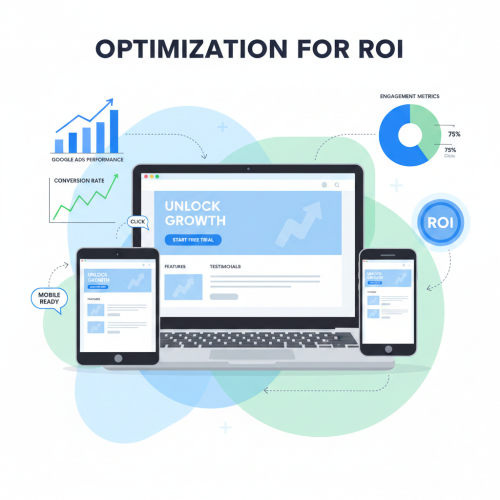
Landing page optimization focuses on improving relevance, usability, and clarity so users find exactly what they are looking for after clicking an ad. When the landing page message aligns closely with the ad copy and user intent, trust increases and conversions improve. Over time, this not only boosts conversion rates but also improves overall Google Ads return on investment (ROI).
Understanding Google Ads Performance
To improve ROI, it is essential to clearly understand how Google Ads performance works and what factors influence campaign success. Google evaluates ads using several important metrics, including click-through rate (CTR), conversion rate, cost per click (CPC), and Quality Score. While strong ad copy and well-researched keywords play a major role in attracting users, they are only the first step in the conversion journey. The real impact is determined after the click, when users arrive on the landing page.
A landing page acts as the bridge between user intent and conversion. If the page aligns closely with the ad message and matches what users are searching for, visitors are more likely to stay, explore, and take action. When users find relevant content quickly, experience clear messaging, and encounter a smooth, user-friendly layout, engagement naturally increases. Higher engagement signals to Google that the ad and landing page are relevant and valuable to users.
This improved relevance positively influences Quality Score, which can reduce CPC and increase ad visibility. On the other hand, if users land on a slow, confusing, or irrelevant page, they are more likely to leave immediately, resulting in low engagement and wasted ad spend. Therefore, understanding Google Ads performance means recognizing that ads
How Improving Landing Page Experience Leads to Google Ads Success
Landing page experience plays a critical role in determining the success of Google Ads campaigns. When users click on an ad, they expect to find content that is relevant, easy to understand, and aligned with the promise made in the ad. If a landing page loads slowly, appears cluttered, or lacks clear direction, visitors are more likely to leave within seconds. This increases bounce rate and negatively impacts conversion rates, reducing the overall effectiveness of the ad spend.
A strong landing page experience focuses on clarity and usability. Clear and concise messaging helps visitors quickly understand the offer and its benefits. Simple navigation keeps users focused on the main goal without unnecessary distractions, while fast loading speed ensures visitors do not abandon the page due to delays. Mobile responsiveness is equally important, as a large portion of ad traffic comes from mobile devices, and a poor mobile experience can significantly lower engagement.
When visitors instantly recognize the value of the offer and know exactly what action to take, such as filling out a form or making a purchase, conversions improve naturally. A positive landing page experience also contributes to a higher Quality Score in Google Ads, which can reduce cost per click, improve ad rankings, and increase visibility. Ultimately, optimizing landing page experience leads to better performance, higher ROI, and long-term campaign success.
Tools to Check and Improve Landing Pages and Ad Performance
- Analytics Tools: Analytics tools, such as Google Analytics, are essential for understanding how visitors interact with your landing pages. They track metrics like bounce rate, session duration, page views, and conversion paths, offering a comprehensive view of user behavior. By analyzing this data, you can identify which pages or sections perform well and which ones fail to engage users. This insight helps marketers make informed decisions about design, content, and calls-to-action. Analytics tools also allow segmentation by device, traffic source, or location, ensuring campaigns are optimized for different audiences. Overall, they provide the foundation for data-driven landing page improvements.
- Heatmap Tools: Heatmap tools visually represent how users interact with your landing page, showing clicks, scroll depth, mouse movements, and attention areas. By using heatmaps, you can quickly identify which elements capture interest and which are overlooked. This information is critical for optimizing the page layout, positioning calls-to-action, and prioritizing content placement. Heatmaps also reveal behavioral patterns that analytics alone may not show, like whether users read content fully or drop off before completing actions. By adjusting design based on heatmap insights, you can improve engagement, reduce friction, and increase conversions while ensuring that high-value content gets the attention it deserves.
- A/B Testing Tools: A/B testing tools allow marketers to compare multiple versions of a landing page to determine which performs best. You can test different headlines, images, layouts, colors, and calls-to-action to see which combination drives higher engagement and conversions. By splitting traffic between variations, you get statistically reliable insights without guessing user preferences. A/B testing also helps identify small changes that significantly impact results, like button placement or headline phrasing. Continuous testing ensures that landing pages evolve alongside user behavior, improving effectiveness over time. This iterative approach maximizes ROI by focusing on designs and content that truly convert visitors into leads or customers.
- Conversion Tracking: Conversion tracking measures the actions users take on your landing page, such as form submissions, purchases, downloads, or sign-ups. By monitoring these key events, you can identify which pages and campaigns are generating meaningful results. Conversion data helps prioritize optimization efforts, as you can focus on pages with high traffic but low conversions. Integrating conversion tracking with ad campaigns allows you to calculate ROI accurately and make data-driven decisions. Understanding user behavior from first click to conversion also uncovers friction points, enabling marketers to improve the funnel, refine messaging, and ultimately boost overall campaign effectiveness.
- Page Speed Testing Tools: Page speed testing tools, like Google PageSpeed Insights, analyze how fast your landing page loads across devices and networks. Page speed is critical because slow-loading pages increase bounce rates and frustrate users, negatively impacting conversions. These tools provide actionable recommendations, such as optimizing images, reducing server response times, and eliminating render-blocking resources. Faster pages enhance user experience, improve mobile performance, and even positively influence search rankings. By regularly monitoring and optimizing page speed, businesses ensure visitors can access content quickly, reducing friction in the conversion process and maximizing the effectiveness of both organic and paid advertising campaigns.
- Google Ads Performance Metrics: Google Ads performance metrics give insights into how well your ads drive traffic to your landing pages. Metrics such as click-through rate (CTR), cost per click (CPC), and conversion rate indicate which ads are most effective. By combining ad data with landing page analytics, you can identify which campaigns deliver high-quality traffic that actually converts. This helps optimize ad spend, improve targeting, and refine messaging. Understanding these metrics also allows marketers to test different landing page versions for high-performing ads. Ultimately, linking ad performance with landing page data ensures better ROI, smarter budget allocation, and more efficient campaign strategies.
- User Feedback Tools: User feedback tools, including surveys, polls, and feedback widgets, collect direct input from visitors about their experience. This qualitative data helps identify pain points, usability issues, and areas of confusion that analytics alone cannot reveal. By asking users about their satisfaction, preferences, or reasons for leaving, you gain actionable insights to improve content, design, and conversion paths. Feedback tools also help prioritize changes that will have the most impact on conversions and user experience. When combined with analytics and testing data, user feedback ensures landing pages align with visitor expectations, resulting in higher engagement, trust, and overall campaign effectiveness.
Common Mistakes That Hurt Google Ads Performance
Even a well-crafted Google Ads campaign can underperform if the landing page isn’t optimized. Many businesses make avoidable mistakes that reduce conversions and increase costs. Here are some of the most common pitfalls:
1. Sending Traffic to a Generic Homepage
Many advertisers send all clicks to their main website homepage instead of a dedicated landing page. The homepage usually serves multiple purposes and can overwhelm visitors. Users coming from a specific ad expect a focused message that matches their search intent. A generic homepage often lacks clear direction, making it difficult for visitors to take the desired action. This leads to higher bounce rates and lower conversion rates, wasting ad spend and negatively impacting overall ROI.
2. Mismatched Ad Messaging
When the content of the landing page does not align with the ad message, visitors may feel confused or misled. Ads set expectations, and the landing page must deliver on them immediately. For example, if an ad promotes a “Free Consultation,” but the landing page discusses general services without highlighting the consultation, users may leave. Mismatched messaging reduces trust, increases bounce rates, and lowers the effectiveness of your ad campaigns.
3. Too Many Form Fields
Long and complicated forms frustrate users and discourage them from completing actions. Asking for unnecessary information can make the conversion process cumbersome. Ideally, forms should request only essential details, such as name, email, and phone number. Simplifying forms improves user experience and encourages more submissions, which directly boosts conversion rates and campaign ROI. Testing different form lengths can help determine the optimal balance between collecting data and maximizing conversions.
4. Unclear Calls to Action (CTAs)
A weak or confusing call to action can leave users unsure of the next step. Phrases like “Submit” or “Click Here” are vague and don’t communicate the benefit of taking action. Effective CTAs are clear, action-oriented, and value-driven, such as “Get Your Free Quote” or “Start Your Trial Today.” Strong CTAs guide users, improve engagement, and significantly increase conversions, making every ad click more valuable.
5. Slow Page Speed
A slow-loading landing page frustrates visitors and increases the likelihood of abandonment. Even a few seconds of delay can reduce conversions drastically. Optimizing images, leveraging browser caching, and minimizing unnecessary scripts can enhance speed. Fast-loading pages provide a smooth experience, keep users engaged, and positively affect both Google Ads Quality Score and overall ROI.
6. Ignoring Mobile Users
Many clicks come from mobile devices, but landing pages often prioritize desktop design. A non-responsive page can be hard to navigate, causing users to leave quickly. Mobile optimization ensures that buttons, forms, and content display correctly on all screen sizes. By providing a seamless mobile experience, businesses capture more conversions and maximize the effectiveness of their ad spend.
By addressing these mistakes, businesses can immediately improve their Google Ads performance and increase conversion rates.
How Optimized Landing Pages Improve Ad ROI
Optimized landing pages are designed with a single goal in mind: converting visitors into customers, leads, or subscribers. Unlike generic pages, these landing pages focus on guiding users toward a specific action, such as filling out a form, signing up for a newsletter, or completing a purchase. Every element on the page—headlines, images, call-to-action buttons, and content—works together to support this objective. Clear and compelling headlines grab attention immediately, while persuasive value propositions communicate why the user should take action. Trust signals, such as testimonials, reviews, or security badges, help reduce hesitation and build credibility.
Simplicity is key: forms with fewer fields, intuitive navigation, and visually organized content make it easy for users to convert. Optimized pages also load quickly and are mobile-friendly, ensuring a smooth experience across devices.
When landing pages are well-optimized, conversion rates increase, which directly reduces the cost per acquisition. This means that businesses can achieve more with the same advertising budget, getting higher returns from every click. Over time, consistently optimized landing pages improve overall ad performance, increase ROI, enhance campaign scalability, and support sustainable long-term growth.
How Digi Atulya Boosts Business Growth
Digi Atulya helps businesses achieve measurable growth by creating a strong and effective digital presence. Many brands struggle to stand out online, but Digi Atulya addresses this through well-planned strategies, targeted campaigns, and ongoing optimisation. By closely analysing user behaviour and engagement patterns, the team identifies what works best for your audience and refines marketing tactics accordingly.
With a focus on results, Digi Atulya ensures businesses attract high-quality leads, increase conversions, and build long-term trust with their customers. From enhancing website performance to optimising landing pages and managing ad campaigns, every step is designed to maximise ROI. The agency also strengthens brand identity across digital platforms, presenting your business as professional, credible, and customer-focused. By combining strategy, insights, and execution, Digi Atulya gives businesses the tools and guidance needed to grow consistently and stay ahead in the competitive digital landscape.
Conclusion
Landing page optimization is a critical component of achieving consistent success with Google Ads. Even the most well-targeted ad campaigns can underperform if users are directed to pages that are confusing, slow, or irrelevant to their search intent. A strong landing page ensures that visitors immediately understand the value of your offering and know exactly what action to take, whether it’s filling out a form, making a purchase, or signing up for a service. By focusing on user experience, fast loading speeds, mobile responsiveness, and clear messaging, businesses can significantly increase conversion rates. Avoiding common mistakes—such as mismatched ad content, cluttered layouts, and overly long forms—further enhances performance. Ultimately, a well-optimized landing page not only improves conversions but also lowers cost per acquisition, boosts Quality Score, and maximizes overall Google Ads ROI. Investing time and effort into landing page optimization is essential for sustainable advertising success.